

When Drones Decide: The Rise of AI on the Battlefield
The new rules of warfare

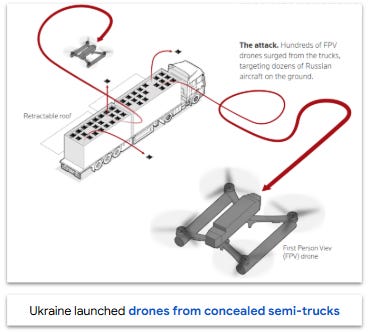
At a Glance: Last weekend, Ukraine launched a “trojan horse” drone attack deep in Russian territory, destroying critical aircraft and infrastructure. Across the globe, military operations are being transformed with AI technologies like targeting, smart missiles and autonomous ships. As these tools become more prevalent, global norms are struggling to keep up, raising concerns that AI will escalate conflicts faster than we can contain them.
Technology on the Battlefield
In 1457 B.C. Pharaoh Thutmose III routed the Canaanites at the battle of Megiddo using an upgraded chariot that carried an on-board archer. In 480 B.C. the Greeks won a crushing victory over the Persian fleet at the battle of Salamis with ships that were faster and more agile. From the Spencer rifle to the atomic bomb and stealth fighter, technical superiority has held the key to modern military supremacy.
Today’s wars are being fought with AI. Drones cause 70% of the casualties in the Russia-Ukraine conflict, and the countries will produce up to 6 million combat drones this year. In Gaza, Israel uses an AI targeting system called Hasbora that combines data signals to identify military equipment, installations and hideouts and a second AI database to assess potential militants using photos, social media and phone records.

Today’s AI War Machine
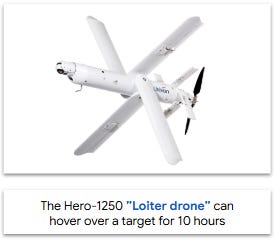
Although most drones are still piloted by humans, AI handles critical functions like flight stability, navigation and target identification. Advanced “Loiter” drones can linger for hours waiting for a target to emerge. Navies use uncrewed ships for surveillance, anti-submarine warfare and mine clearing. Smart munitions like cruise missiles, glide bombs and guided artillery shells use AI to increase targeting precision.
Beyond the battlefield, AI integrates data from GPS, radar, video and sensors to provide cohesive real-time battlefield status information. The Pentagon’s “Thunderforge” planning system uses this data as a basis for AI-powered wargaming and scenario evaluation. Operationally, AI systems coordinate global military supply chains and increase equipment availability through predictive maintenance.
Breaking Battlefield Norms
AI systems create new challenges for military leaders. While AI-based targeting promises increased precision and reduced civilian casualties, it is only as good as its data and algorithms. Many operate as “black boxes,” making decisions without clear visibility. Battlefield conditions make testing difficult, and errors have grave consequences.
Today’s advanced weapons are growing too complex for humans to directly control. Systems like drone swarms, hypersonic missile defense and dogfighting jet pilots require split-second decision-making beyond human cognitive ability. In 2017 the Pentagon gathered more than 22 terabytes per day: that’s more than 5 seasons of NFL football footage every 24 hours.
Perhaps the toughest challenge is the lack of deterrence. Historically an attacker risks its own casualties, but when a drone or unmanned vehicle is destroyed, its pilot remains safe back at headquarters. Analysts fear this could lead to more civilian casualties as generals launch more aggressive attacks.
The pace of AI change has advocates pressing governments to regulate AI’s use in war, including the UN’s “Agenda for Peace” that called for banning autonomous weapons. Many fear a “governance lag” as the new technologies outpace our ability to establish rules and norms.
My take: A New Geopolitical Chessboard
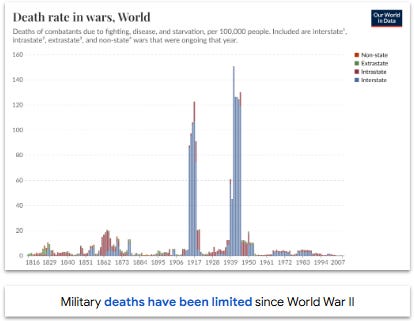
Our world has experienced remarkable stability since the Atomic Bomb created the Cold War. This will change in the next decade as China replaces Russia as the U.S.’ main geopolitical rival. The U.S. leads in AI and defense technology but China dominates manufacturing, robotics and power generation.
It’s unlikely that China and the U.S. will enter into a direct conflict as each stands to lose more than it would gain. The bigger concern is with smaller nations. As AI becomes widely accessible and cheaper, what’s to stop them using it to gain an advantage? Traditional antagonists like Pakistan, North Korea, Iran and Turkey are all investing in military AI.
Earlier this month, India and Pakistan renewed their decades-long fight over Kashmir. This clash broke from precedent as the countries launched AI powered drones and missiles deep into opposing territory, near nuclear facilities. They also used AI deepfakes to spread misinformation and fear among citizens. They eventually de-escalated under pressure from the U.S., China and the UN.
This shows the risk and the promise of the next military era: Mankind’s fortunes will hinge as much on peacemaking as it will in designing the best AI-powered drones.
Dad Joke: One AI drone asked the other: What’s your favorite kind of music? It said: “I’m a big metal fan” 😆