

Watts Up with AI? Why Electricity Is the New Bottleneck
The energy crisis grows

At a Glance: This week, the U.S. congress debates the fate of the federal budget’s electrical energy subsidies while Amazon, Nvidia and Meta make billion-dollar investments in power generation. Energy is becoming a key bottleneck as AI continues its rapid growth and tech companies are innovating and building new capacity to avoid disruption.
The War of the Currents
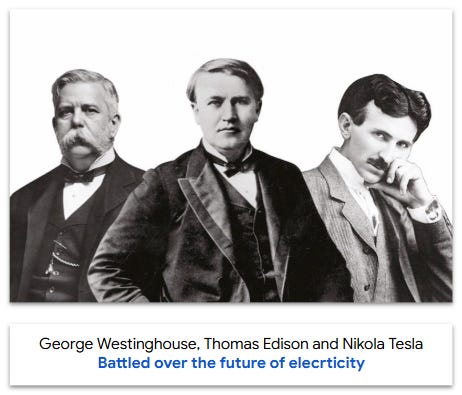
In the 1880s, Thomas Edison and George Westinghouse staged a battle over the future of electricity. The “War of The Currents” pitted Edison’s Direct Current (DC) against George Westinghouse Alternating Current (AC) system pioneered by Nikolai Tesla. Edison fought dirty by electrocuting dogs, horses and an elephant to sow distrust of AC power. Despite these tactics, Westinghouse won the contracts for the 1893 World’s Exposition and Niagara Falls Dam. AC was better at long-distance transmission and cheaper and became the standard, paving the way for the electrification of society including electric lights, modern appliances and computers.
I’ve got the power
U.S. electricity primarily comes from five sources:
Natural Gas (40% of capacity), a “cleaner” fossil fuel, is replacing Coal (16%) as the workhorse of the electrical grid.
Wind (12%) is the cheapest form of new energy, but installations are complex, expensive and can face resistance from residents.
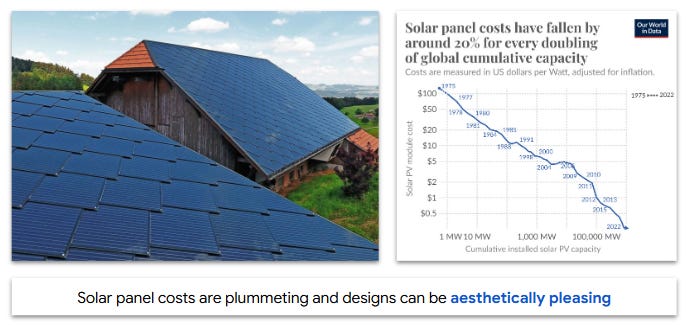
Solar (8%) is surging, as prices have plummeted by more than 20x since the 1990s. Panels are modular, easy to install and aesthetically pleasing.
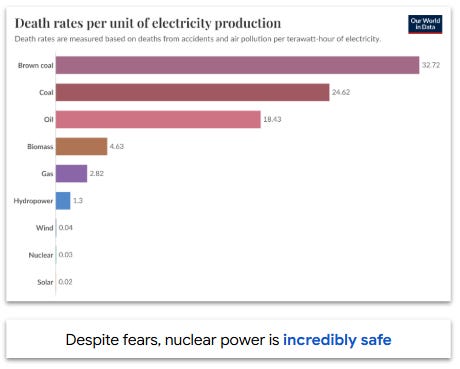
In spite of public fears due to disasters at Chernobyl and Fukushima, Nuclear (19%) is one of the safest energy sources available. Next-generation designs are virtually failsafe and the U.S. government has set a goal to quadruple capacity by 2050.
Power to the People
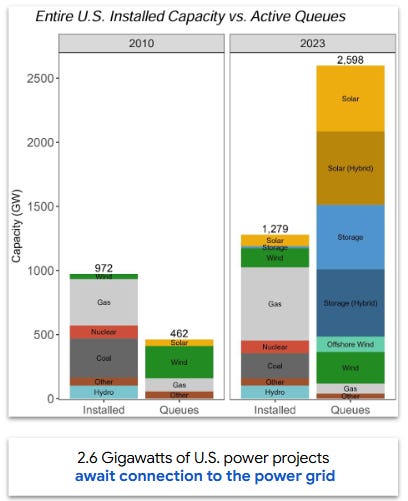
Companies face three challenges when building new plants: First they must find a site that is available, affordable, close to demand and agreeable to local residents. Then they must obtain hundreds of permits across a labyrinth of overlapping federal, state and local agencies. Finally, they have to queue for a grid hookup which can take years due to a massive backlog. Combined, these hurdles slow and sometimes end projects: A recent NuScale nuclear project in Idaho spent seven years and $500 million obtaining approvals before being canceled due to escalating costs.
Power Hungry AI
AI models train by doing math at a massive scale: trillions of words, images and videos are converted into numerical “tokens” and processed using advanced calculus. GPT-4’s training run took over three months and involved 21,000,000,000,000,000,000,000,000 (2.125) operations and consumed 62 Gigawatt-hours of power, enough to power 5,000 homes for a year.
A similar process happens when models are used. While each individual query is trivial (⅓ of a watt), billions of daily questions add up and inference consumes 80% of AI’s power needs. Sam Altman once remarked that users saying “please” and “thank you” in their prompts cost OpenAI tens of millions of dollars in electricity.
Power Struggle
AI’s power demand is expected to quadruple by 2030, with datacenters consuming up to 12% of all domestic capacity. Access to cheap energy is becoming a chokepoint for AI with Nvidia CEO Jensen Huang saying “The number one constraint for AI right now is electricity”.
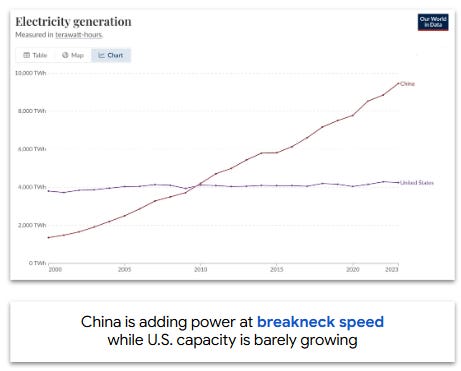
This demand has geopolitical implications as China has more than twice America’s energy capacity and added more new solar than the U.S. produced in 2024. While the U.S. leads in chips and software, China’s electrical capacity advantage could help it leapfrog American companies.
The Power of Positive Thinking
AI is being used to solve the energy crisis it’s intensifying. Model builders are improving training: Nvidia’s latest chips use 30x less power than prior models, while new training methods from Google distribute needs to under-utilized power sources.
Power companies are improving delivery through smart grids that use AI for forecasting and allocation and load management. They are also balancing sources: nuclear provides high-density, always-on, carbon-free power while other buildouts pair cost-efficient solar and wind with natural gas backup for cloudy, windless days.
Tech companies are investing in new capacity to avoid being bottlenecked or undercut by competitors like China’s DeepSeek: Microsoft is revitalizing Three Mile Island, OpenAI is partnering with UAE and Saudi Arabia on solar datacenters, and Google, Amazon, and Nvidia are investing in private buildouts.
While these solutions mostly focus on AI, they provide overall benefits like reduced grid strain and consumer costs.
My Take: Looking for Optimism
In 2018, our family went to Alaska for summer vacation. My highlight was hiking the Harding Icefield: we set out through a lush rainforest and ended atop a glacier wearing sunglasses to see across a sea of snow and ice. The hike’s breathtaking views masked a stark reality: the glacier had receded by a half-mile since the turn of the century due to our warming planet. If this continues, I worry that my son Alex may not be able to do this hike with his own kids.

Here’s the thing: AI eats up a ton of power. But what if it’s the very thing that helps us solve the world’s energy crisis? The good news is that tech companies are already pouring resources into renewable energy and new innovations. I’m optimistic this trend will stick, and AI will play a huge part in keeping our planet healthy.
Dad Joke: One windmill said to the other “What’s your favorite type of music?” It replied “I’m a big heavy metal fan”. 😭