

The OG Returns to the Stage: Google's Gemini 3
AI's Original Gangster

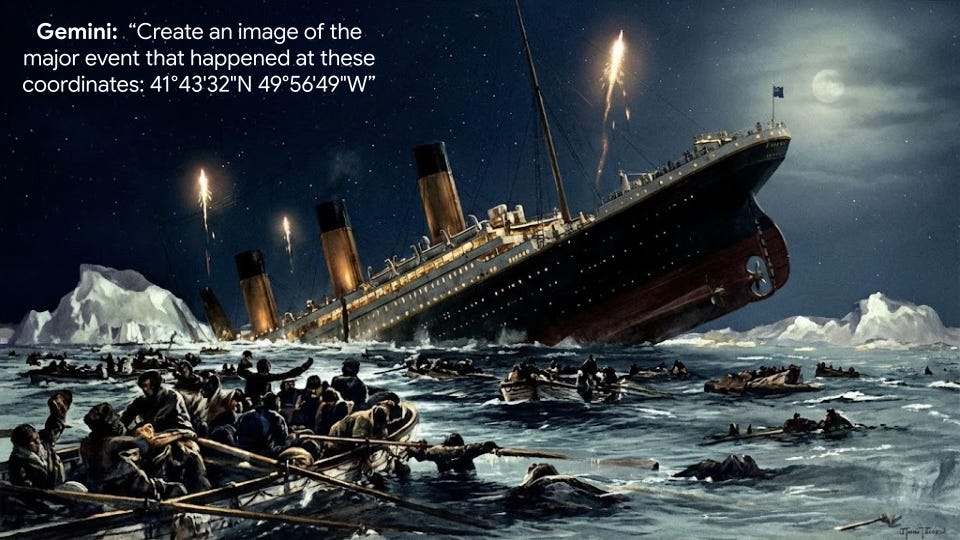
Google invented the T in ChatGPT. That’s right! The biggest product launch in recent history is based on Google’s work. But you wouldn’t know it. Last week a friend told me they “Googled it in ChatGPT”. 🤔
The last three years have been rough. ChatGPT captured the world’s imagination while Google was panned for mistakes and corporate inertia.
Google is the original gangster (“OG”) of AI. And it’s on the comeback trail.
Losing the Beat
ChatGPT’s launch was a gut punch to Google. It reached 100 million users faster than any product in history. Suddenly ‘just Google it’ had a competitor.
Google looked every bit the lumbering corporate giant that couldn’t get out of its own way. Its two internal AI teams, Google Brain and DeepMind, took uncoordinated research approaches. Its chatbot “Bard” gave a wrong answer in its launch demo, and later on told users to put glue on pizza and eat rocks. And it didn’t stop there. Google’s image generator created pictures of Black founding fathers and Asian Nazi soldiers.
Google’s stock dropped nine percent after the Bard demo. Outsiders questioned whether Sundar Pichai was the right leader or if Google needed a “wartime CEO”.
Google’s Receipts
GPT stands for generative pre-trained transformer. It’s based on the Transformer paper published by Google Brain in 2017, the most cited paper in the history of AI.
AI is in Google’s DNA. Larry Page called AI the “ultimate version of Google” in 2000, and CEO Sundar Pichai declared the company “AI-first” in 2016. Its talent runs deep. DeepMind CEO Demis Hassabis won a Nobel Prize, and Jeff Dean and Noam Shazeer are legends in the field.
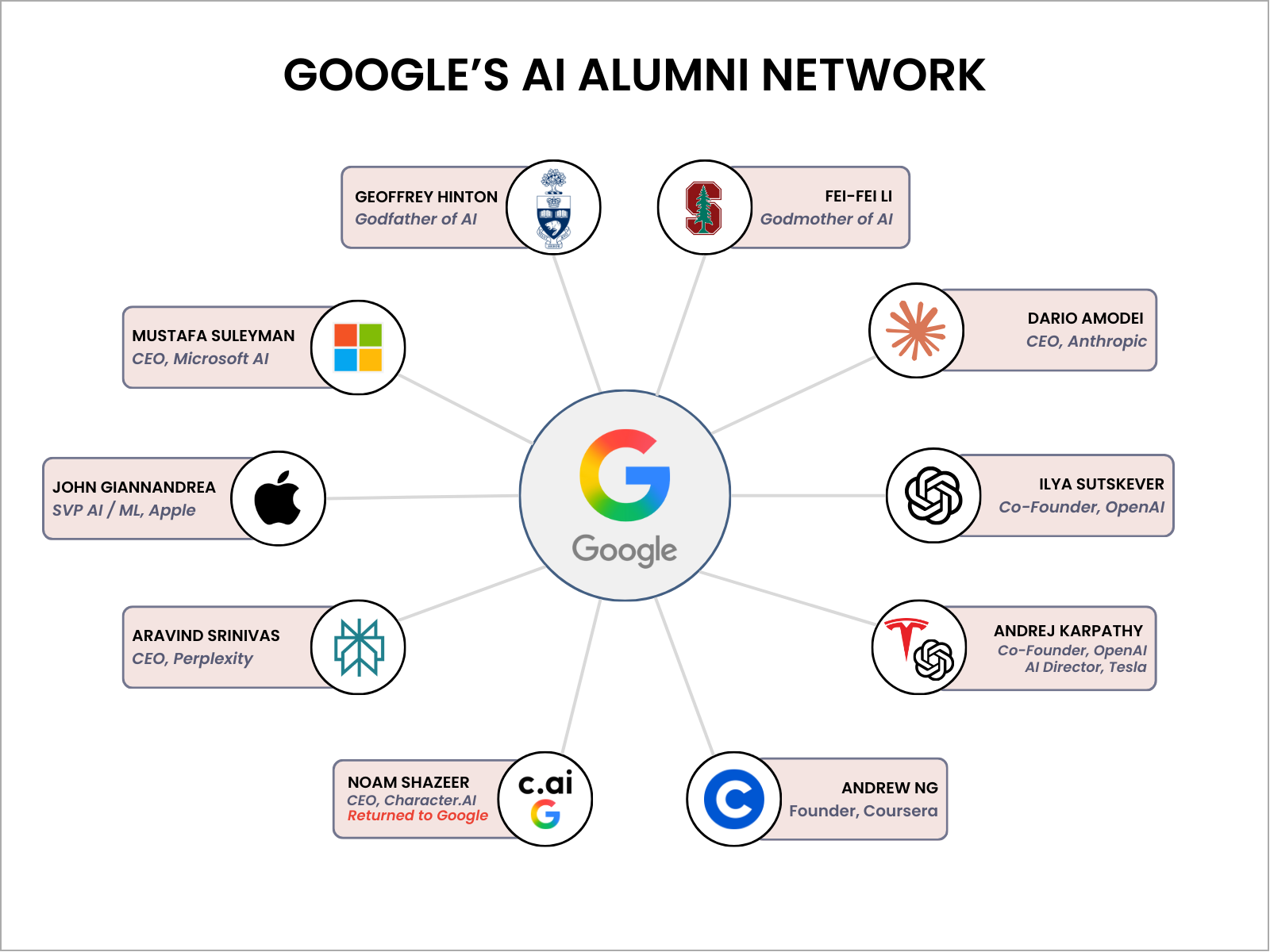
Google didn’t just invent the technology behind the AI boom. It also trained its competition. Dario Amodei (Anthropic), Ilya Sutskever (OpenAI), the heads of AI at Apple and Microsoft... all are former Googlers. Fourteen of today’s top 50 AI startups are led by Google alumni.
Google was already using AI heavily by 2021: Translate, autocorrect, type-ahead, driving directions, photo enhancements. One team even proposed replacing the classic search ‘blue links’ with AI answers, two years before ChatGPT launched.
So what in the heck happened?
The Backstage View
Two theories explain why Google didn’t launch an AI chatbot:
The first is user trust. Google guards search like a religion. I saw this culture firsthand. I once passed along a friend’s feedback on organic results and got my hand slapped. The team was nice, but firm: employees follow the same process as everyday users. That rigor made Google great at search, but also made shipping a chatbot unthinkable, especially when hallucinations were common.
The second is money. Google makes over $250 billion a year from search ads. Why rush to replace a proven business model with something untested? AI answers cost more to generate, and no one knows if ads will work as well alongside them.
But you can’t show ads to users you don’t have. ChatGPT forced Google’s hand.
Back in the Studio
Three weeks after ChatGPT launched, Sundar Pichai declared an internal “code red”, mobilizing the entire company to catch up. And he meant it: he folded Google Brain into DeepMind, consolidated safety teams, and cut red tape to get products out the door. Even co-founder Sergey Brin returned to work with the Gemini team.
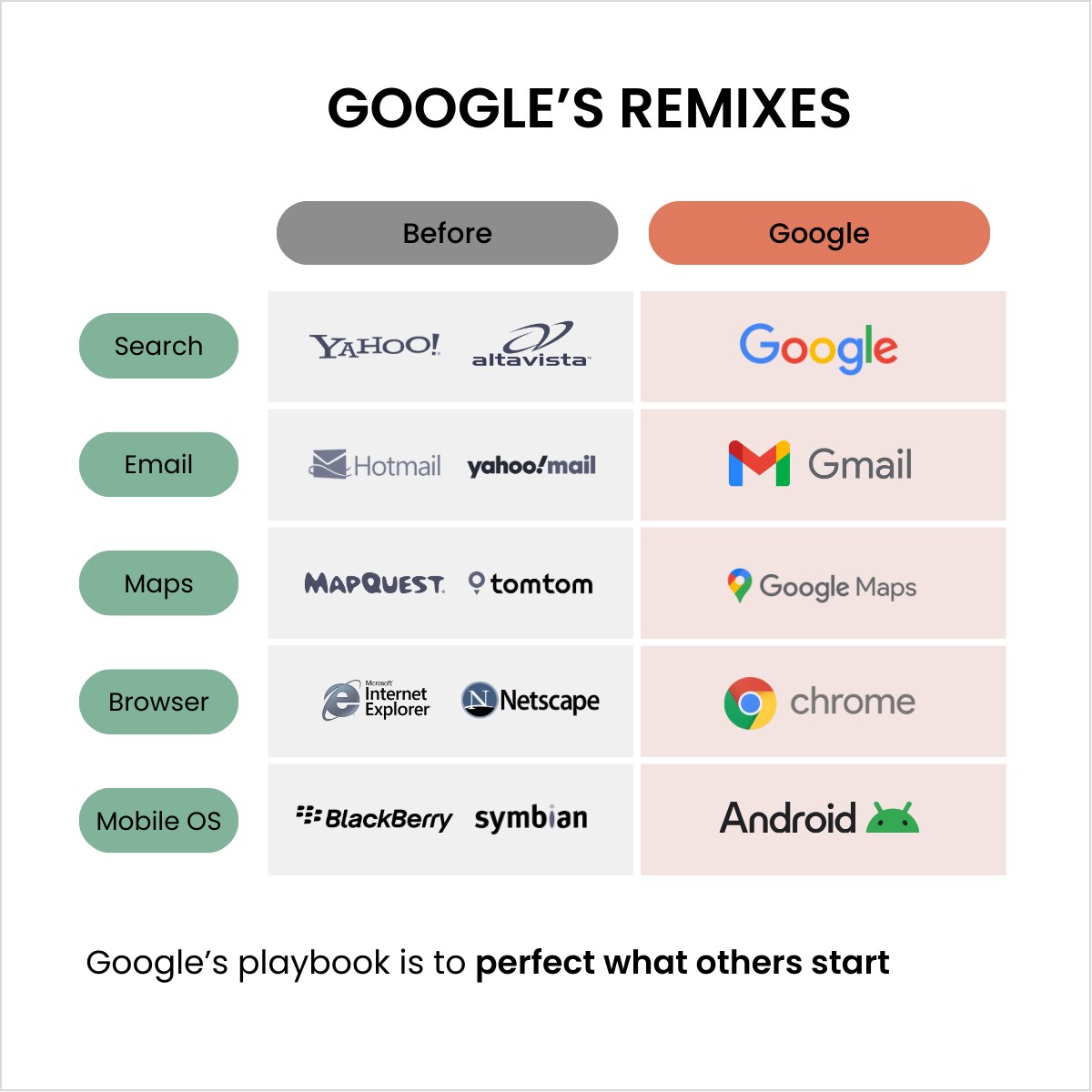
If this sounds familiar, it should. Google Search wasn’t first (remember Yahoo?), nor was Gmail (Hotmail anyone?) or Maps (here’s looking at you, MapQuest). Google rarely invents a category, but it often perfects it.
And with Gemini 3, Google’s done it again.
The Comeback Tour
Gemini went straight to number one, taking the lead across nearly every major benchmark.
The reviews were glowing. Salesforce CEO Marc Benioff wrote: “Holy s—t. I’ve used ChatGPT every day for 3 years. Just spent 2 hours on Gemini 3. I’m not going back.”
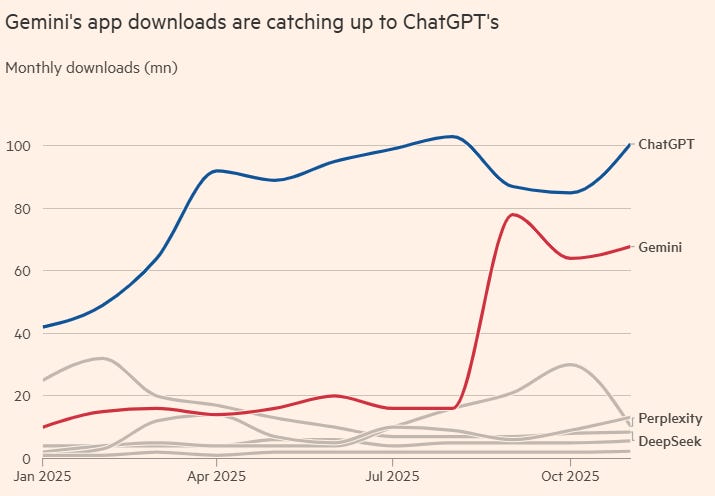
Gemini’s active users grew 30 percent from August to November, while ChatGPT grew only 5 percent. The app now has 650 million active users, up from 90 million a year ago. Investors cheered, sending the stock up 6% on launch day and 13% since.
So what are users raving about?
Gemini’s New Hits
Gemini’s hallmark is its ability to work across text, image, and video. A few examples making the rounds:
The Inception Explainer: Ask Gemini to explain the movie and it builds an interactive exhibit you can click through and explore.
Personal Assistant: “Ask it to Organize my Gmail” and it creates draft replies, follow-up reminders, and archive suggestions.
The Live Mechanic: One user recorded Gemini giving step-by-step oil change instructions tailored to their car’s make and model.
Google’s Full Ensemble
Gemini 3 is a great product, but ChatGPT is still the clear leader, answering 2.5 billion prompts a day to Gemini’s 400 million. Anthropic’s Claude is the favorite among programmers, and its latest release was hailed by some as the best overall model. Ironically, Sam Altman announced his own “code red” to defend against Gemini three years after Google did the same.
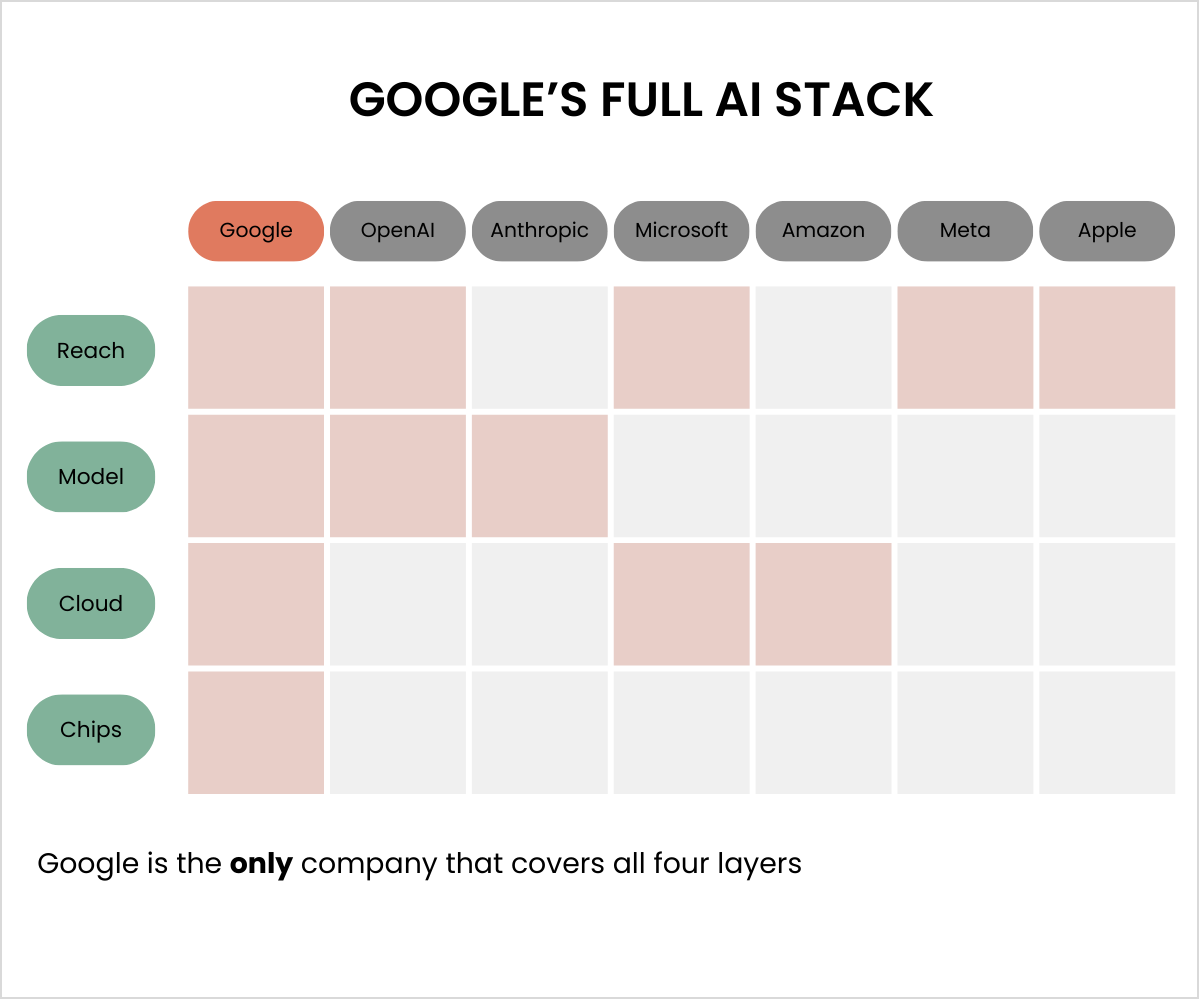
Google’s biggest advantage is that it does…everything. It’s the only company that covers the full AI stack: mass user reach, leading models, cloud services, and chips.
And while the Gemini app logs ‘only’ 400 million user chats a day, its answers appear in more than 2 billion search “AI overviews” and across Google’s entire portfolio including Gmail, Chrome, Docs, and Maps.
Google also a deep war chest with $100 billion in cash and nearly $70 billion in free cash flow every year.
Why Google’s Comeback Matters
In a final twist, Google’s AI floundering probably saved it from a worse fate.
Last year Judge Amit Mehta found Google had an illegal monopoly in search. But instead of breaking up the company, he imposed lenient penalties, saying “the emergence of GenAI changed the course of this case” and “tens of millions of people use chatbots like ChatGPT to gather information they previously sought through internet search.”
Just a year ago, it looked like ChatGPT might become the next tech monopoly. It had a huge head start, strong brand buzz, and explosive user growth.
But that has changed. The race is now wide open. That means better features, lower costs and more choice. Three companies fighting to earn our trust.
That is why I’m glad to see the OG back on stage.
Dad Joke: Why did the OpenAI programmer visit a fortune teller? He wanted his code read. 😂
Thanks for reading!
If you enjoyed this edition, share it with someone who wants to see an OG return to glory.