

Search in the Balance: Google’s AI Tightrope Act
Sticking the landing

At a Glance: Last Wednesday Alphabet shares dropped 7% when Apple executive Eddy Cue testified that Google search volume on Apple’s Safari web browser declined for the first time in two decades. Chatbots are the likely culprit: many of those queries are shifting to ChatGPT’s growing user base. Because AI results cannibalize ad clicks, Google must add Gemini quickly to retain users while protecting margins, advertiser trust and meeting looming legal penalties.
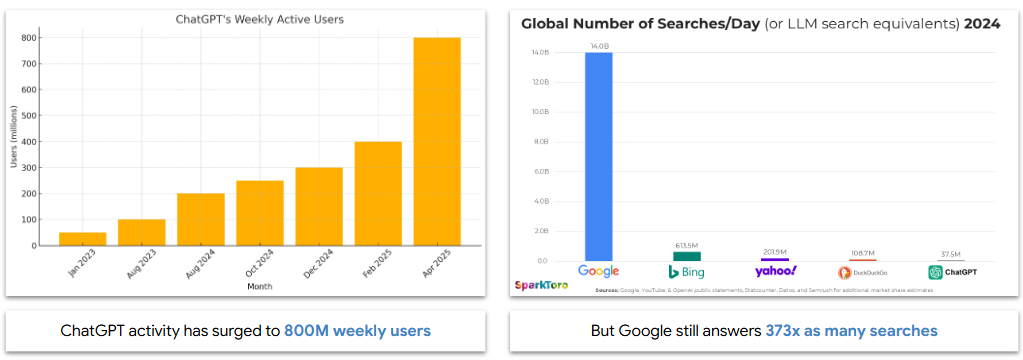
ChatGPT Crosswinds
Search ads are the core of Google’s business, driving nearly four-fifths of Alphabet’s $100B net profit in 2024. NYU professor Scott Galloway called search “the best, most lucrative business model of this millennium.”
ChatGPT took the world by storm after launching in November 2022. As many as 800 million people now use it every week, valuing its conversational interface and rich, integrated answers. A September 2024 survey found that 8% of users chose ChatGPT as their default search engine instead of Google.
In December 2022, Google CEO Sundar Pichai declared a “Code Red” to address OpenAI’s threat. Google had been slow to deploy AI in search despite inventing the technology in 2017. This urgency paid off, and by 2024 it launched Gemini, a top-tier model and added AI overviews at the top of its search results.
Walking the Wire
Unlike apps like TikTok and Instagram who make money the longer users scroll, Google succeeds when they leave. Every click is a success; users find what they need, publishers gain traffic and advertisers pay Google for the visit. AI upends this model: early research shows that many AI results answer questions on-site, cutting clicks by up to 35%.
Legal challenges have added to the impact of AI. In 2024 Judge Amit Mehta ruled Google maintains a monopoly in internet search through deals with companies like Apple, whom it pays $20B per year to be the default search engine for the iPhone. The judge is reviewing proposed remedies like banning placement deals, making it share data or forcing it to sell its Chrome browser.
This contest is one for the ages. OpenAI has first-mover advantage and startup agility, while Google counters with talent, custom AI chips and billions of existing users. Google’s challenge is to integrate AI while protecting its search lead.
My Take: Sticking the Landing
The Innovator’s Dilemma by Clayton Christensen paints a paradox in which dominant firms (Kodak, Blockbuster, BlackBerry) ignored or underfunded a new technology only to see upstarts embrace it and win.
During my 14 years working at Google, Search was….boring. Profitable, but boring. We added features here and there, but it wasn’t that different from the 10 blue links when I started in 2011.
Google faces this dilemma with search. While ChatGPT’s user activity is tiny compared to Google’s 5 trillion searches in 2024, AI chatbots look like the next leap. Google must walk a tightrope: while users trust it to deliver accurate results and advertisers rely on its traffic, AI results are error-prone and drive fewer ad clicks. Move too slowly and lose early adopters; too quickly and risk losing trust.
Google must entice users to continue to think Google first:
Gradually transition search to an AI experience. Google is moving with discipline here by adding AI overviews and testing a new chatbot-like “AI mode”.
Embed Gemini into its family of billion-user products like Gmail, YouTube, Maps and Photos to build comfort and familiarity.
Continue partnering with device manufacturers to drive traffic while complying with antitrust rulings.
The good news? AI has sparked a new wave of innovation at Google. The ten blue links are fading, and instead of being profitably boring, Google has to reinvent search. Search on!
🛠️ Try This: Opt into Google’s new “AI Mode” experiment to get a feel for moving back and forth between standard Google results and the Gemini chatbot experience.
Dad Joke: “An AI walked into a search bar. It said, ‘Ouch, I should have looked where I was going.’” 🤕😆