

OpenAI’s $6.5B Bet: Can Jony Ive Design the Future of AI?
What If?

At a Glance: Last week OpenAI announced an $6.5B acquisition of “io”, a startup founded by Jony Ive to build a personal AI device. The move bypasses smartphones and gives OpenAI direct access to users. It’s risky given the history of failures in the device market. If successful, this puck-shaped assistant could redefine how humans use AI.

Sir Jony’s Next Crusade
Io was founded by Jony Ive, a renowned designer and British cultural icon who led Apple’s design team for 27 years. Steve Jobs called Ive his “spiritual partner” and his minimalist style defined products like the iPhone, iPod, Apple Watch and iOS user interface. His goal with io is to redefine how humans interact with AI in daily life.
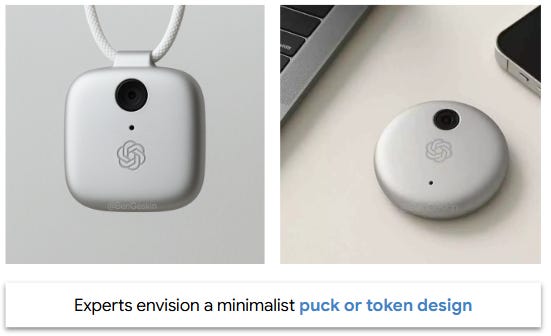
Io’s new device is reportedly a “screenless AI companion” that would eliminate the need to pull out a phone or laptop to access AI. Few details have been released but observers expect a small puck-shaped object that could be worn as a pendant or set on a desk. It would be voice activated, fully aware of a user’s surroundings and interactions, and sync with a user’s smartphone and earbuds.
Breaking the Chokepoint
Personal devices are critical because their makers control access to the Internet. Google pays Apple $20B per year to be the iPhone’s default search engine and is reportedly spending “enormous sums” to preinstall Gemini on Samsung phones. When Apple launched new privacy tracking features in 2021, it cost Meta an estimated $10B in advertising revenue, and it responded with full-page newspaper ads calling Apple anti-competitive. Since then Mark Zuckerburg launched a $100B strategy to build the metaverse, eliminate its dependency on iOS, and changed its company name to “Meta”.
This dynamic is existential for OpenAI, as its users could be co-opted into existing offerings from Google and Apple. Last week Google announced that it is adding “AI Mode” into its core search experience, where users can access Gemini without opening another app. ChatGPT is just one of many model options available to “Apple Intelligence” users. Selling a device would give OpenAI direct access to its users, reducing this reliance on others.
Hardware is Hard
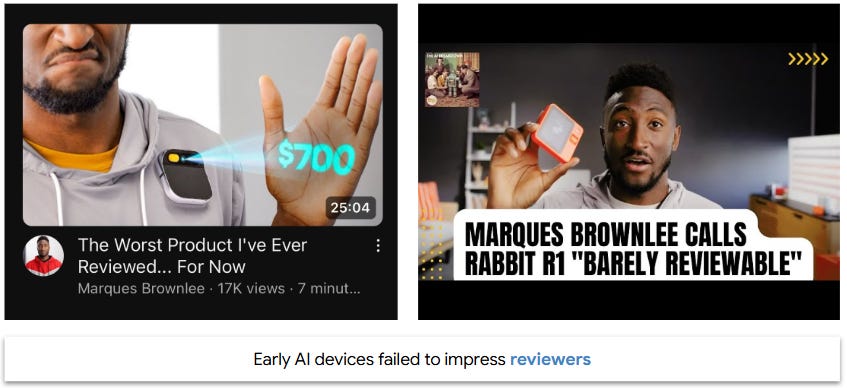
The personal hardware landscape is littered with roadkill: just ask someone who bought an Amazon Fire Phone. Google’s Glass, Facebook’s Portal, Snap’s Spectacles and Spotify’s “Car Thing” all failed despite investor backing, design innovation and aggressive marketing. The Humane pin and Rabbit R1 AI devices were brutally reviewed for their limited usefulness.
Success requires answering difficult questions. Why carry a third device that does the same thing our smartphones do? How will friends and co-workers react to a device that records all of our conversations? How will we feel about trusting OpenAI with every detail of our day-to-day lives? Unlike Humane and Rabbit, will this device actually work? Even if it works, how long until Apple or Samsung launches their own versions like they did with watches and earbuds?
What if?
These are real challenges. To succeed a new device must be genuinely useful, not just eye-catching. But what if AI is actually that good? Imagine an AI saying this:
“Matt, you didn’t pick up your credit card after paying at the restaurant.”
“Matt, the train you’re hustling to catch is running 5 minutes behind.”
“Matt, there is no parking on this side of the street for street cleaning today.”
“Matt, you’re about to drive by your dry cleaner, and your clothes are ready for pickup.”
“Matt, I can give you feedback on the executive presentation you delivered this morning.”
These examples require something our phones don’t offer: always-on context, situational awareness and real-time help. At the current pace of AI progress, they could be real by 2026. If OpenAI pulls it off, it won’t just have a cool gadget, it will define the next era of personal technology.
No Dad Joke this week, Ive run out of ideas. 🤔