

From Librarian to Concierge: Google, AI, and the Future of the Web
ChatGPT crashes the party

At a Glance: Last week, publishers accused Google of “trampling the open web” after a study showed AI Overviews cut traffic by 25%. But the real story isn’t clicks disappearing, it’s how traffic is shifting.
During my years at Google, we told companies to optimize for outcomes, not clicks, and that advice has never been more urgent. Google isn’t killing the web, it’s evolving from a digital librarian into a digital concierge. The companies that understand this shift will thrive; the rest will be left wondering where their clicks went.
The Internet’s Most Successful Middleman
Google’s mission statement is: “To organize the world’s information and make it universally accessible and useful.” This is no small feat. The internet is mind-bogglingly vast: 371 million websites, hundreds of billions of pages, and a search index weighing in at over 100 million gigabytes.
Here’s what makes Google unique: While Facebook, Instagram and TikTok want to keep you scrolling for hours, Google’s goal is the opposite: “to have people leave our website as quickly as possible.”
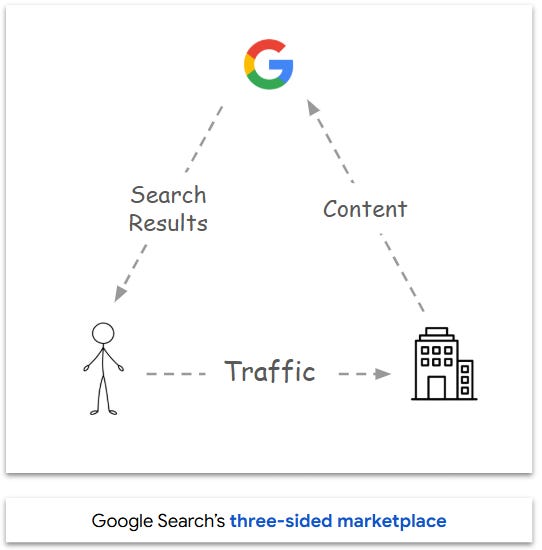
To do this, Google built what economists call a three-sided marketplace:
Users want answers, whether that’s “best pizza near me” or “Do vegetarians eat animal crackers?”
Website creators want attention, to sell products, share knowledge, or grow subscribers.
Advertisers want to reach people at the moment they’re ready to buy.
Google sits in the middle, taking a cut from advertisers while delivering answers to users and traffic to sites. For over two decades, this “town square” model worked beautifully.
The Uninvited Guest
Then ChatGPT crashed the party. Within two months it hit 100 million people, the fastest-growing product in history. Suddenly, millions discovered they could get answers much easier: Why search “symptoms of food poisoning” and click through five different medical sites when ChatGPT could give you a comprehensive answer in seconds?
The convenience was irresistible. By June 2025, AI search engines had grabbed 5.6% of U.S. desktop search traffic, more than doubling in just one year.
Google’s hand was forced. They had spent years perfecting their three-sided marketplace, but users were voting with their clicks. To stay relevant, Google needed to offer what users wanted: immediate answers, not just links.
Google Strikes Back
Google’s response was AI Overviews, summaries that appear above traditional search results. These answers dramatically increased the number of “zero-click” searches where users get their answer without leaving Google. For news searches, the share jumped from 56% to nearly 69%. When summaries are present, users click links only 8% of the time, versus 15% without them.
Not surprisingly, publishers sounded alarms. William Lewis, CEO of The Washington Post, called it “a serious threat to journalism.” Barry Diller, chairman of IAC, said, “I’m on the edge of revolt.”
Their concern is real, but the numbers tell a more complex story.
Fact-Checking the Fact Checkers
It’s true AI Overviews reduce clicks from search. But overall Google traffic isn’t vanishing, it’s shifting. Google referrals to publishers are actually up to 19% of traffic, compared with 15.5% in 2019. But the mix has shifted: more than twice as many visits now come from Google Discover as from traditional search. The stream is still flowing, it’s just finding new channels.
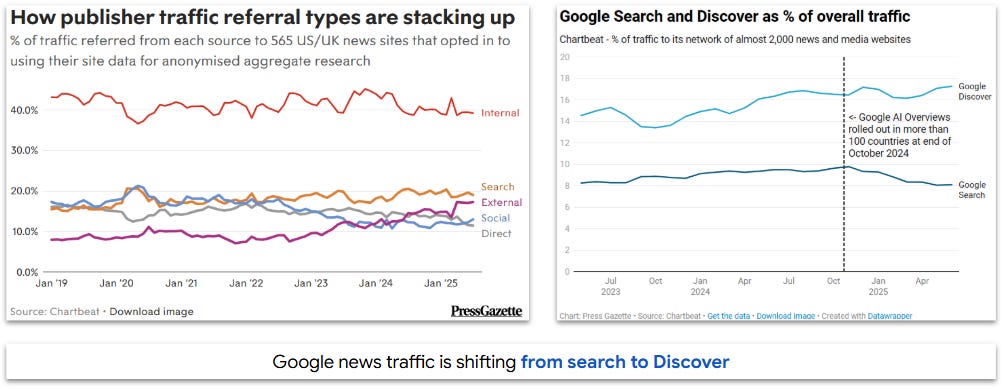
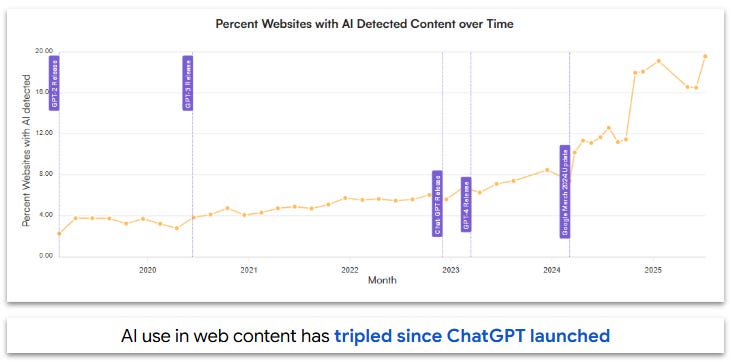
So why are companies losing traffic? Because the internet itself is exploding. Common Crawl reports that billions of new pages go online every month, and nearly one in five websites now use AI to churn out content. Watchdogs are flagging hundreds of AI-driven news sites, and competition for attention has never been fiercer.
It’s like owning a shop on Main Street, then waking up to find yourself in the middle of Times Square. You haven’t changed, but the competition for attention has exploded.
From Links to Answers
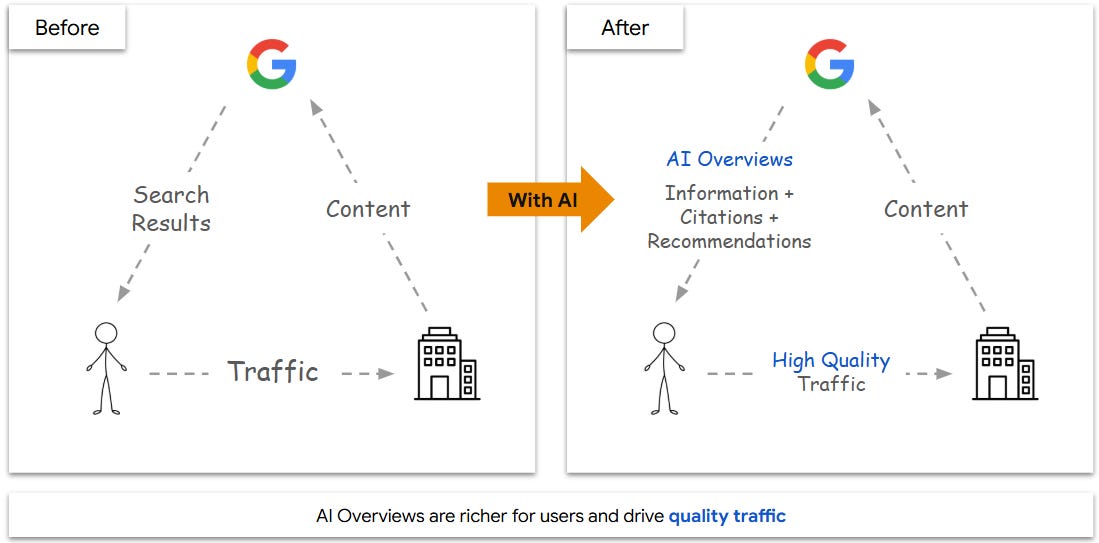
AI-enabled search results are fundamentally different from ten blue links. Instead of sending you shopping, AI is like a friend who knows exactly what you need.
AI answers provide rich, comprehensive responses along with citations, like word-of-mouth recommendations at scale. If you’re an expert or researcher, you want your work cited in these authoritative answers. If you’re a consumer business, you want AI talking positively about you, which means maintaining a digital footprint that reflects your brand well. If you’re a government or service organization, you want AI to have the right information to answer people’s questions.
And here’s the twist: AI search doesn’t just change where people click, it changes how they arrive. Adobe found visitors from AI-enhanced results are more engaged (8% higher) and less likely to bounce (23% lower).
My Take: It’s About Outcomes
At Google, we challenged companies to optimize for outcomes, not clicks. That’s never been more important than today. The question isn’t “How do I get more traffic?” It’s “Why do I want traffic?” Are you after sales, reputation, or attention?
Visibility in AI answers is just the starting point. You need to provide value AI can’t replicate:
Unique assets – proprietary data or content (Zillow’s housing database)
Useful tools – calculators, planners, or interactive features (TurboTax prep calculator)
Personal touch – personalization or community (Amazon recommendations, Reddit discussions)
Real-world action – transactions and bookings (Shopify checkout, OpenTable reservations)
AI can tell someone how to change a tire. It can’t sell them the tire, schedule the repair, or build the loyalty that brings them back.
Most importantly: AI-driven visitors often arrive ready to act. Don’t send them to a homepage built for casual browsing. Help them finish the job.
The open web isn’t dying, it‘s being remodeled. AI-driven answers are now the front door. The real question isn’t whether people will use the concierge, it’s whether the concierge will recommend you.
Dad Joke: What do you call medical students who graduated from an online university? Google Docs! 🤣