

Ctrl-Alt-Degree: Rebooting the classroom for AI
Cheating or AI Literacy?

At a Glance: Earlier this month, New York magazine’s “Everyone Is Cheating Their Way Through College” article laid bare the widespread use of ChatGPT at universities. Most students rely heavily on chatbots, dulling the hard work that was key to mastering subjects. The traditional “do the work, earn a degree” path is cracking as assignment answers are one-click away. Professors are racing to update their approaches and teach the skills needed in an AI-based workplace.
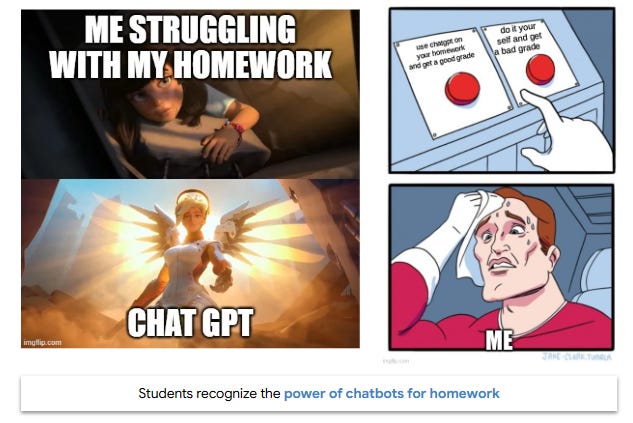
AI Ate My Homework
AI has become a default at college. A 2024 survey found that 86% of students use AI tools like ChatGPT. Efforts to detect AI use are ineffective and bans have mostly resulted in students developing the ability to mask the use of AI in classwork.
Many compare the rise of AI chatbots to the calculator or Wikipedia, both of which were initially considered “cheating” but were eventually accepted. In contrast, Chatbots span nearly every academic domain. They also reason, generating answers to assignments from essays to programming to analysis.
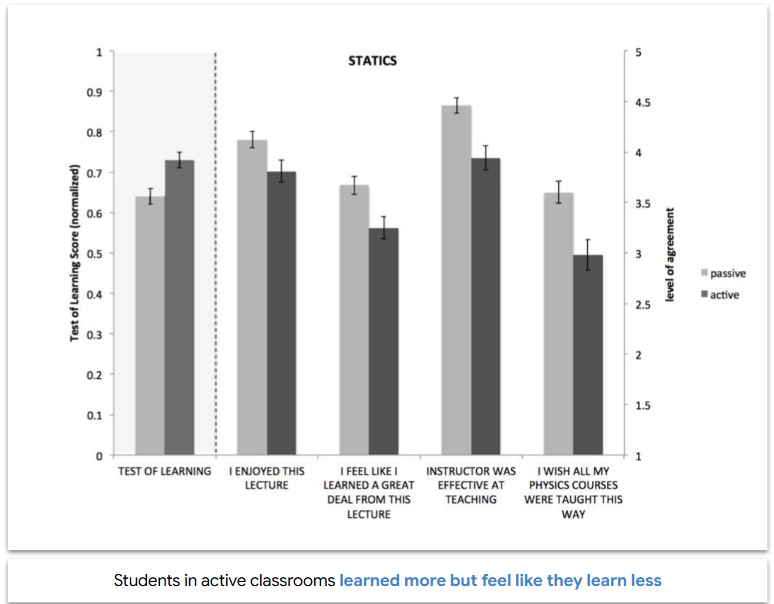
Learning is hard! Struggling with essays or wrangling calculus problems is painful, but that pain is how we learn. When students use AI instead of doing the work, they often develop surface level knowledge but not enough to explain or build on it later. A 2024 Wharton study found that ChatGPT boosted homework scores by 48%, but when it was removed performance dropped to 17% below baseline, showing how little real learning actually took place.
An Expiring Contract
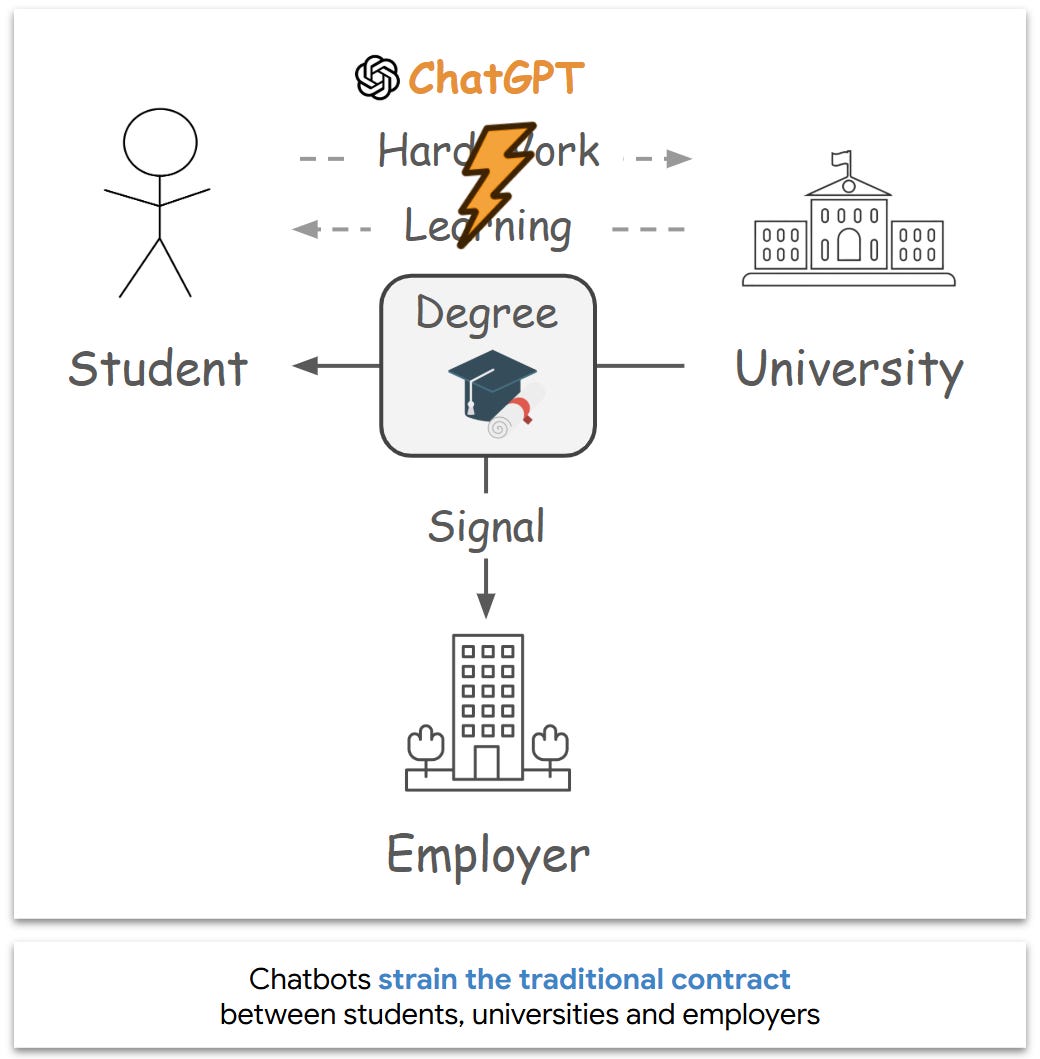
There has been an unspoken deal between students and universities. Students put in the work by going to class, doing homework, studying and passing exams. In return, they earn a degree, which combined with a GPA signals their ability for future employers.
AI chatbots threaten this contract by shortcutting the learning process. Students face a regular dilemma: should I grind through an assignment myself or get a quick answer from a chatbot? Teachers have a related challenge: how do I evaluate a student’s work product that may be AI-created? And institutions must evaluate: how do I ensure a degree carries weight in the marketplace?
Classroom 2.0
Teachers are adjusting to AI with quick fixes like in-person exams and personal or reflective assignments. Forward thinkers are encouraging chatbot use and adding things like virtual tutors, AI simulations and AI-based grading bots.
Some educators are asking the deeper question: what skills are needed where creation is a click away? As a baseline, humans need the knowledge and ability to verify AIs that often hallucinate. Beyond this, AI literate humans need to gather context, create ideas, think critically and synthesize perspectives across humans and AIs.
My take: A 21st century Gutenberg
Johannes Gutenberg’s printing press didn’t just upend European religion and science, it reshaped education. Students went from reciting and hand-copying manuscripts to reading textbooks and developing skills in interpretation and original thought. AI is poised to do the same. In the AI-enabled classroom, student work will increasingly shift from creating to verifying, ideating, critiquing and synthesizing.
Some professors are already blazing this path. At Wharton, Stefano Puntoni’s AI and our Lives class explores the complexities of human-AI relationship through the lens of behavioral science. At UNC, David Ringel had 200 students, many with no coding experience, build chatbots from scratch, helping them understand both the technology and its practical use. And at UW, Katie Gaertner complements her AI fundamentals course with an UNSupervised podcast spotlighting the school’s latest research on AI in business.
The next renaissance in education will be led by instructors like these who see AI not as a threat to learning, but as a tool to help students develop skills that matter most in a world reshaped by its power.
🛠️ See for yourself: Run an A/B test on your email. Write one by editing a chatbot’s answer and one by hand to see the difference in your speed and learning.
Dad Joke: “Why did the AI bring a ladder to the exam? Because it heard the test had high-level questions.” 🤔😆