

Beyond GPT-5: The Opening Acts That Stole the Show
Going beyond the chatbot

At a Glance: OpenAI’s long-awaited GPT-5 finally arrived this week, but it wasn’t the only story, or even the most important one. Alongside it came an open-source model that could power thousands of startups, a copyright-safe music generator that pays creators, and a Google breakthrough that turns text into fully interactive 3D worlds. GPT-5 shows where large language models are headed, but these “opening acts” point to an AI industry that is broadening beyond the basic chatbot.
GPT-5: The Event of the Year?
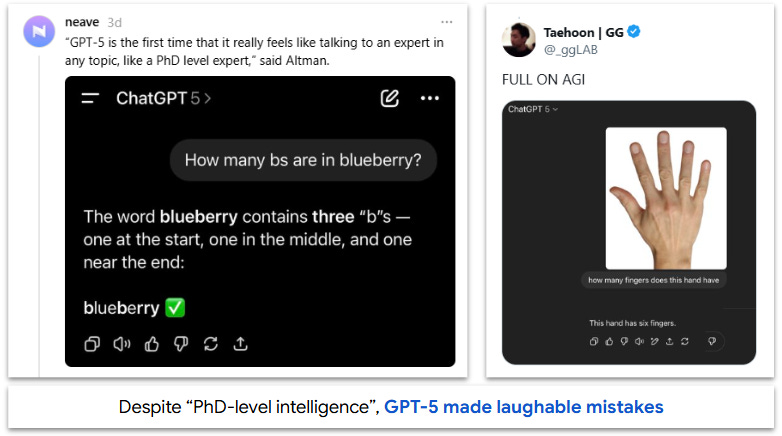
After months of anticipation, OpenAI unveiled GPT-5, its first major release in over two years. CEO Sam Altman set high expectations, calling it a “legitimate PhD expert.”
Despite the emphasis on expert-level capabilities, most of the benefits targeted everyday consumers: faster responses, simpler user interface, safer answers, fewer hallucinations and more support for coding.
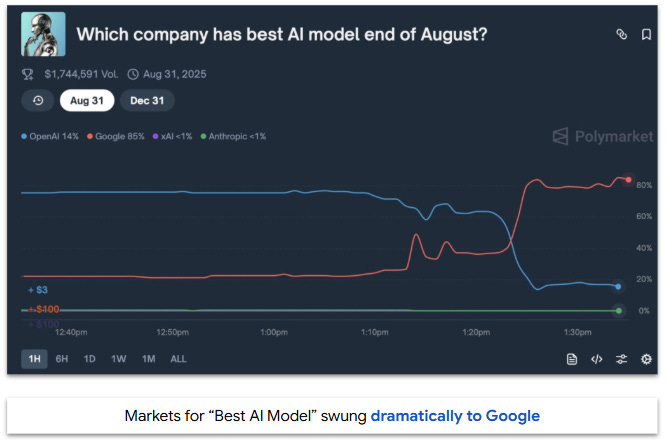
Early feedback was rocky. Users flagged basic errors in math, counting, and image recognition. Pro users criticized losing model selection controls, with some launching petitions to bring back earlier versions. Most dramatically, a poll flipped from OpenAI leading with 75% to Google taking the top spot, with OpenAI falling to just 14%, all within an hour.
PCMag summed up the sentiment: “GPT-5 feels more like an incremental improvement than a science-fiction game changer.” Altman acknowledged: “it was a little more bumpy than we hoped” and blamed technical issues the company is addressing.
OpenAI Opens the Gates
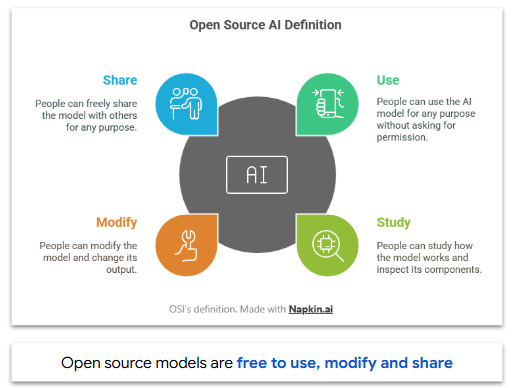
Perhaps the bigger surprise from OpenAI was its release of a new open-source model. Unlike paid products, it is free for anyone to use, modify, or commercialize. The community welcomed it as cutting-edge and competitive with top Chinese models like DeepSeek.
The model comes with robust safety features, refusing to generate dangerous content even when modified. However, this safety-first approach created trade-offs: people quickly noticed it’s “spiky,” excellent at solving physics problems or writing code but struggling with creative writing or casual conversation.
Developer Kyle Corbitt explained the trade-off: training on synthetic data rather than scraped web content was “almost certainly to avoid copyright lawsuits.” This highlights a competitive disadvantage: Chinese companies face fewer constraints and can train on any data they want.
Still, having a leading American open-source option is crucial for startups, researchers, and companies needing full control over their AI systems. And while this doesn’t necessarily vault OpenAI into the lead, it’s a strong start.
These Go to 11
While everyone debated GPT-5’s shortcomings, a quieter release from Eleven Labs tackled AI’s biggest legal headache: copyright protection. Unlike other music AI companies, the system was trained only on legally obtained data and provides payments to musicians who opt-in to the program.
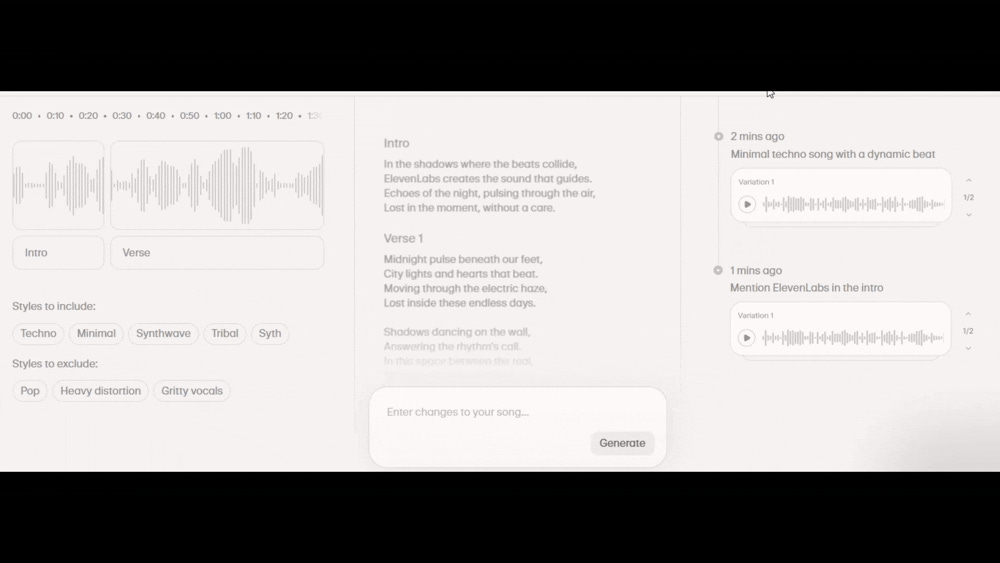

For example, you could type “upbeat corporate background music with guitar and light percussion, 90 seconds” and get professional-quality audio ready for a marketing video. The applications are extensive: companies need original music for advertisements, training videos, podcast intros, presentations, and social media content, all without worrying about licensing fees or copyright lawsuits.
This gives Eleven Labs a significant advantage in the corporate market. Companies choosing AI music providers will increasingly demand legal protection, forcing competitors to either rebuild their systems from scratch using legal data or risk losing customers. What started as Eleven Labs solving their own legal problems could reshape how the entire AI industry approaches creator compensation.
Genie Out of the Bottle
The most mind-bending release of the week was Google’s Genie 3, which generates realistic 3D worlds from simple text prompts. Think of it as ChatGPT for reality itself.
Here’s how it works: you type something like “a cozy kitchen with marble countertops, morning sunlight streaming through windows, and tea brewing on the stove.” Within seconds, Genie 3 creates a fully interactive 3D environment you can walk through. You’re not just viewing a static image: you can open cabinets, turn on faucets, and watch steam rise from the teapot.

The physics accuracy is what makes this revolutionary. Water flows with proper fluid dynamics, objects respond to gravity naturally, and lighting casts realistic shadows and reflections. Most impressively, Genie 3 has persistent memory. You can save your created world and return to it later. The teapot will still be there, the morning light will remember its angle, and any changes you made during your first visit remain intact.
The potential applications are vast. Video game developers could prototype entire levels in minutes. Medical students could practice procedures in generated operating rooms. Therapy patients could explore recreated childhood homes or practice mobility skills in safe virtual environments. Autonomous vehicles could practice navigation in thousands of generated scenarios like narrow streets, busy markets and snowy mountain passes all without putting a real car on the road.
Currently limited to research previews, Google plans to release it for beta users later this year.
My Take: When the Opening Acts Steal the Show
This week reminds me of a Taylor Swift concert I went to with my daughter. Taylor “slayed”, Camilla Cabello “ate that” and Charli XCX was “straight fire”. My daughter assures me these are all glowing reviews!
Just like that concert, GPT-5 may have been the headliner everyone came to see, but the opening acts stole the show:
OpenAI’s open-source model could become the foundation for thousands of companies who need cutting-edge AI without vendor lock-in.
Eleven Labs offers a path to solving copyright by training responsibly and paying creators.
And Genie 3 leaps from text to world generation, opening entirely new categories we’re just beginning to imagine.
Sometimes the smaller acts are the ones that stick with you, and they could be selling out arenas next year.
Dad Joke: What does the intelligent genie with a split personality call itself? A GeniUS! 🎓😄