

America Built AI. Now It's Not So Sure.
So much for "Person of the Year"

On Thursday Time named “The Architects of AI” as its 2025 person of the year. Its cover image featured Elon Musk, Mark Zuckerberg and a host of other Big Tech CEOs. The reactions were fast and mostly negative.
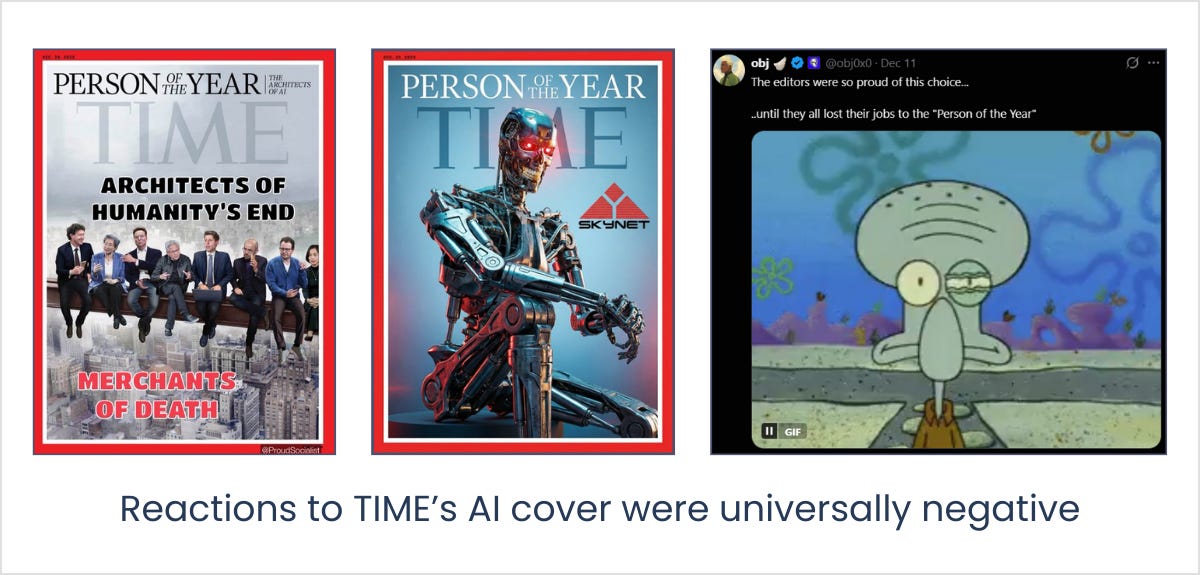
The backlash builds on a rising wave of AI fears. AI content is especially unpopular, with Coca-Cola’s AI-generated holiday ads panned as a “sloppy eyesore”.
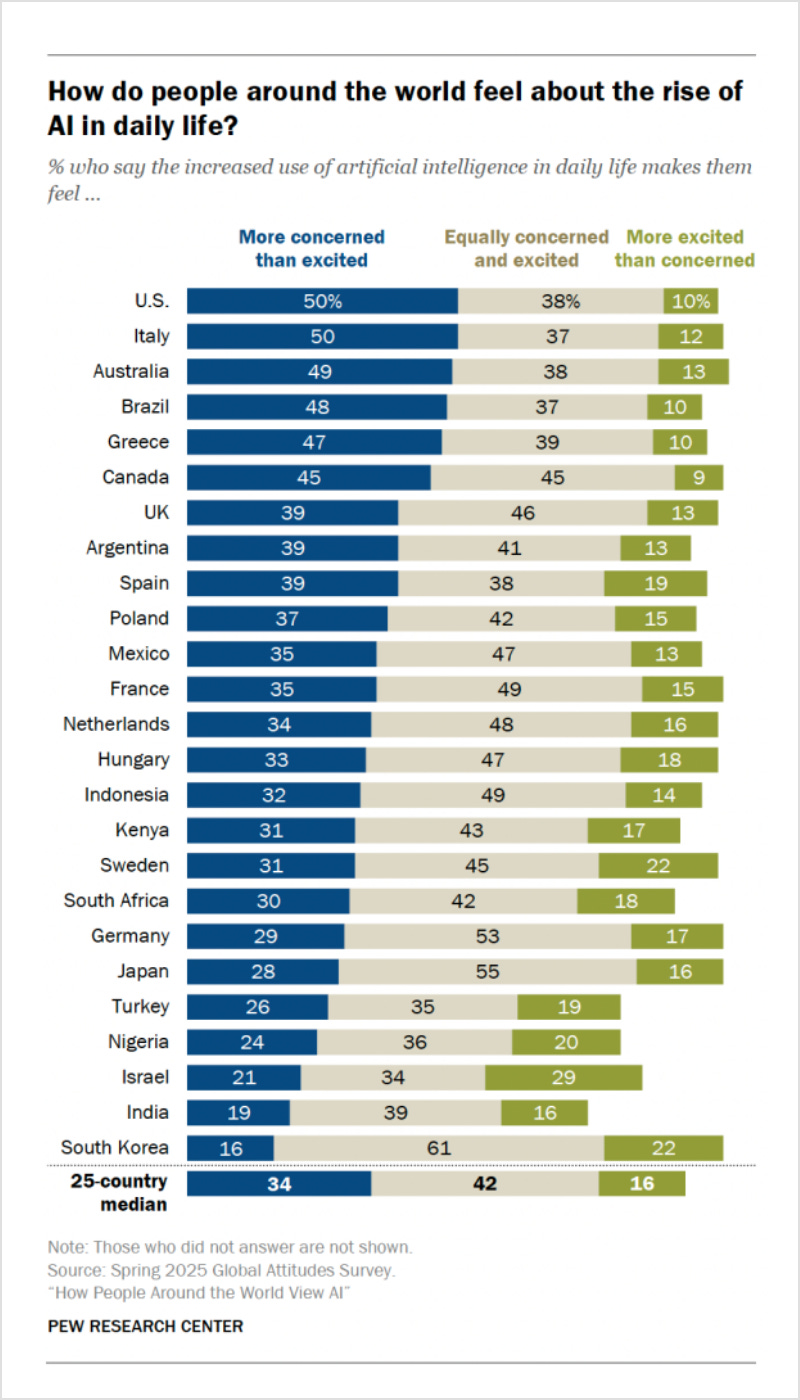
Americans have the most negative perceptions of AI in the world, with 50% holding an unfavorable opinion.
America is the birthplace of Silicon Valley, the PC, the Internet, the iPhone and now AI. Why are we so down on AI?
The easy answer is that we’re worried about losing our jobs. And while that’s valid, there’s more to the story.
AI cuts to the core of the American spirit.
The Honeymoon Years
In 1995, I went to an “Internet Party” at my co-worker’s apartment. We huddled around his computer, which was connected to the internet via CompuServe and a 14.4K modem. We surfed sites like GeoCities, bantered in chat rooms, and laughed at the world’s first live webcam: the “Trojan Room Coffee Pot”.
From the launch of the PC through the mid-2010s, Americans had a love affair with technology. Steve Jobs and his black turtleneck became a cultural icon. Jeff Bezos and Mark Zuckerberg were both named Time’s Person of the Year. Apple fanboys camped out overnight to buy the latest iPhone models.
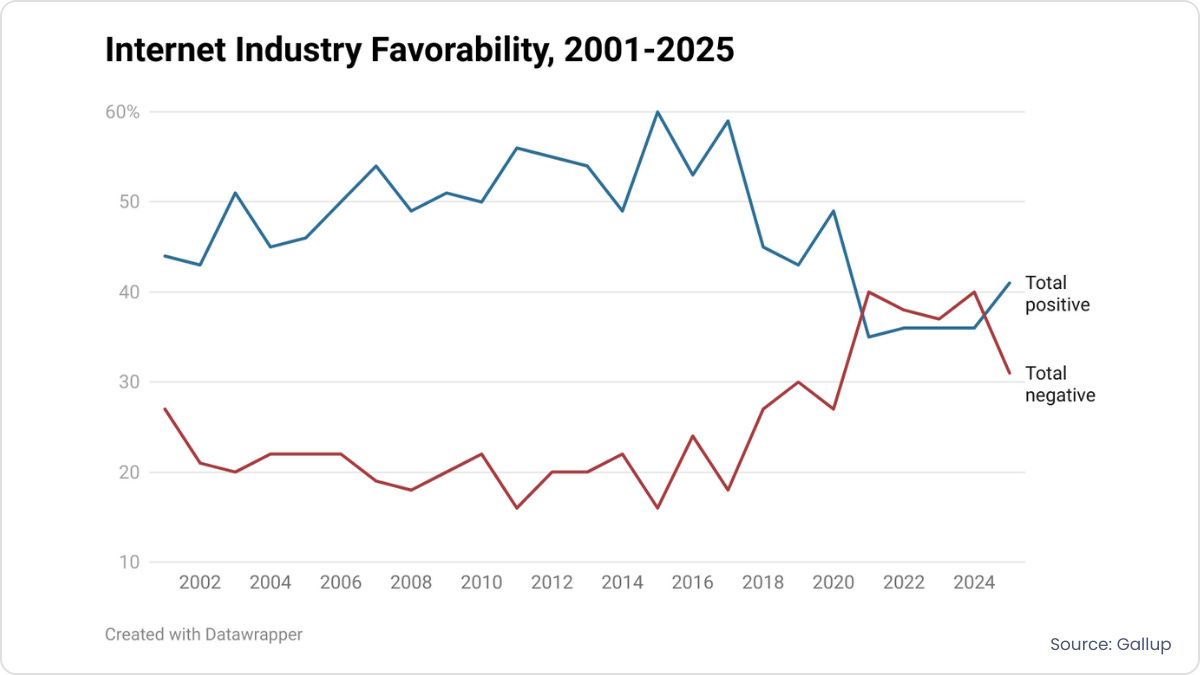
The internet revolution was a global phenomenon and it was led by American companies: Google, Apple, Microsoft, Facebook, Amazon, Intel. Public confidence peaked in 2018, when the internet industry hit 60% favorable and just 10% unfavorable ratings, the highest of any industry.
Big Tech was on a roll. But it wouldn’t last.
“You are the Product”
In 2018, the Cambridge Analytica scandal broke. The firm exploited Facebook’s loose privacy standards to harvest millions of users’ personal data for political ad targeting.
Then came a bigger reckoning around the business model itself. Apps like Facebook, Instagram and YouTube were free, but maximizing ad revenue meant keeping users hooked. A 2020 Wall Street Journal exposé revealed that Instagram leaders knew its content was harmful for teenage girls, but did nothing.
Congress stepped in, holding public hearings and calling tech CEOs to testify about the damage their products were causing.
By 2024, public perception of the internet industry had dropped to 36% positive, turning net negative for the first time.
AI landed in the midst of this valley.
More than a Bad Ad
Remember that Coca-Cola ad? It featured Coca-Cola trucks driving through a snowy wonderland of animals and beautiful lights.
People hated it. But when I looked for specific complaints, they were surprisingly hard to pin down. The wheels on the truck looked wrong, but is that really a big deal? There’s something deeper going on.
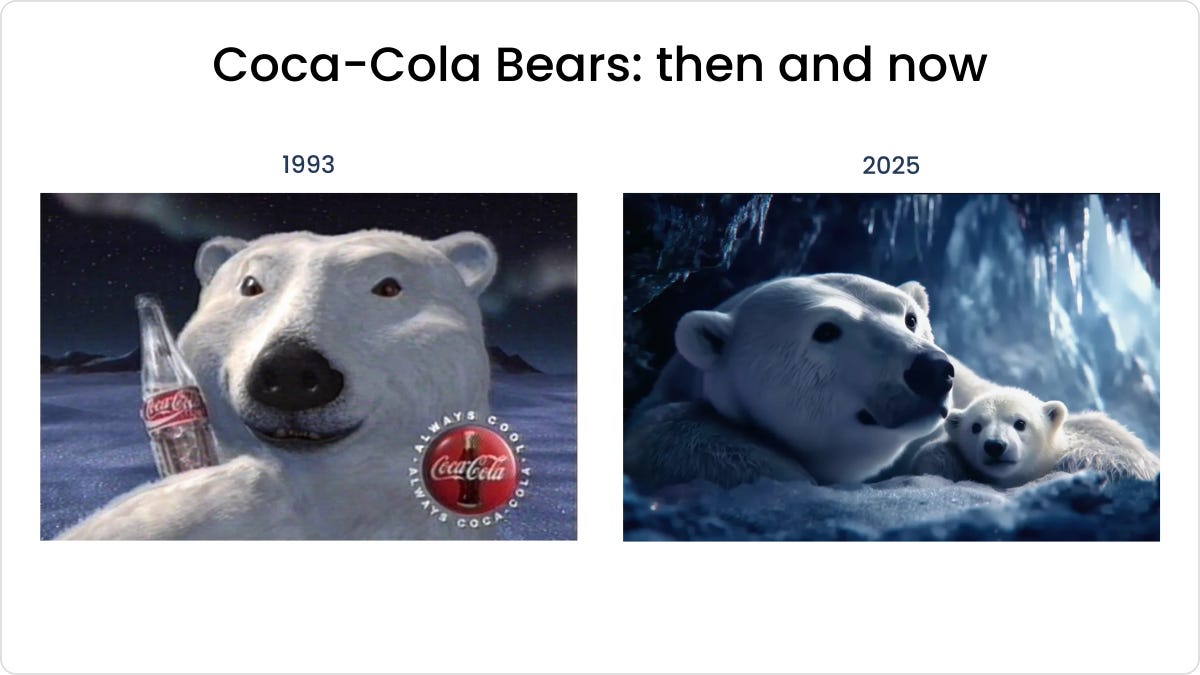
Think back to 1993 when Coca-Cola released its original polar bears ad. It was made with CGI, which was bleeding-edge at the time. And we loved it! Same with the T-Rex in Jurassic Park. We loved these moments because they showed us something we’d never seen before. The reaction was “holy cow, I can’t believe what I just saw.”
The AI Coca-Cola ad is...fine. The animals look real, and the lights are pretty. But it’s not creating anything new. Our reaction isn’t awe, it’s “okay, and?”
AI doesn’t have to replace people to feel threatening. But it does. Most Americans’ first encounters with AI are as a substitute: writing an email, making an image, watching a video.
That’s a huge difference. The internet, the smartphone, even the wheel all made humans more capable. AI skips straight to the output, especially in areas of human expression.
Nobody mourned fax machines when email replaced them. But writing, art and music are different. They aren’t just tasks to be optimized. They are how humans say “I made this.”
American Exceptionalism
This hits Americans particularly hard. Our national identity is built on individual achievement. The songwriter in Nashville, the novelist in Brooklyn, the ad designer on Madison Avenue: these aren’t just jobs, they’re identities. Hollywood, Silicon Valley, the music industry: we’re the country that makes culture.
So when Americans see an AI-generated Coca-Cola ad, the reaction isn’t really about truck wheels. It’s about watching a machine do something a human could have done, in a domain where human creativity was supposed to be the point, in a country that built its identity on being the place where that creativity happens.
It’s not just creativity. We dominate the knowledge economy. With 4% of the world’s population, America generates 25% of global GDP. We export intelligence: content, strategy, design, code.
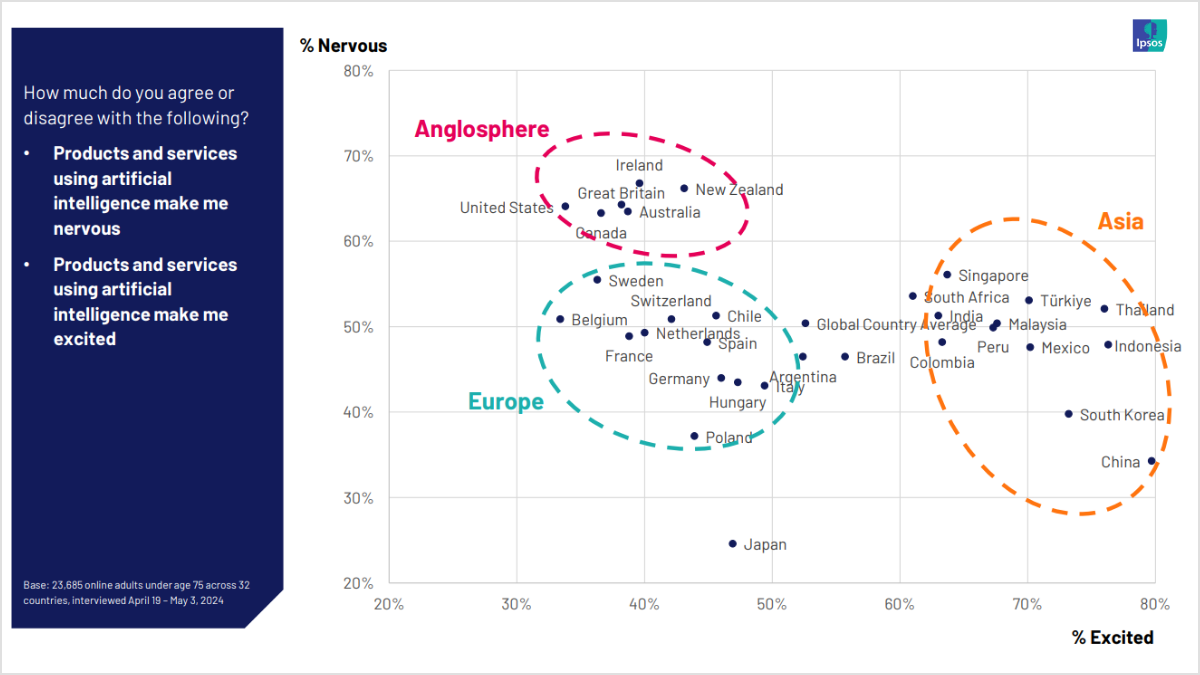
No wonder Americans are skeptical. And we’re not alone. Other Anglo countries like the UK, Canada, and Australia are equally nervous about AI. Meanwhile, Asia and Latin America are far more optimistic, because AI looks like a ladder to prosperity.
Mourning What Hasn’t Happened Yet
Four of my in-laws are therapists. 🧐 They have a term for mourning a loss before it happens: anticipatory grief. This is a natural human reaction, and a healthy one. People who grieve in advance often handle loss better when it arrives, as long as they don’t wallow in it.
No country is feeling this with AI more than America. We invented it. OpenAI, Google, Nvidia, Anthropic, the rest…all American. AI is in our midst, and it challenges what makes us unique.
Fears about AI are legitimate, whether its jobs, skill erosion, or authenticity. But AI also hits at the core of knowledge and creative work where America leads the world.
The countries that lead the AI era won’t just be the ones who have the best AI technology. They’ll be the ones who figure out how to make it a superpower instead of a replacement. America’s technologists built AI. Now we need to learn how to use it.
Dad Joke: What did Coca-Cola fail to learn from their AI ad backlash? Not everything bears repeating. 😆
Thanks for reading!
If you enjoyed this edition, share it with someone who can’t put their finger on their AI grief.