

AI and the Entry-Level Job Market: Warning Signs and Record Salaries
The canaries are confused

At a Glance: Is AI destroying entry-level jobs? New Stanford research shows younger workers are losing ground in roles impacted by AI while other studies show minimal impact to employment. AI-native graduates are commanding record salaries while the traditional apprentice model is coming under strain. Amid this uncertainty, the once-cute tagline “You won’t lose your job to AI, you’ll lose it to someone else using AI” is becoming a reality.
Chatbot Canaries: A New Signal in the Noise
From corporate executives to college students and their worried parents, people are anxious to know what the future holds for the traditional entry-level job.
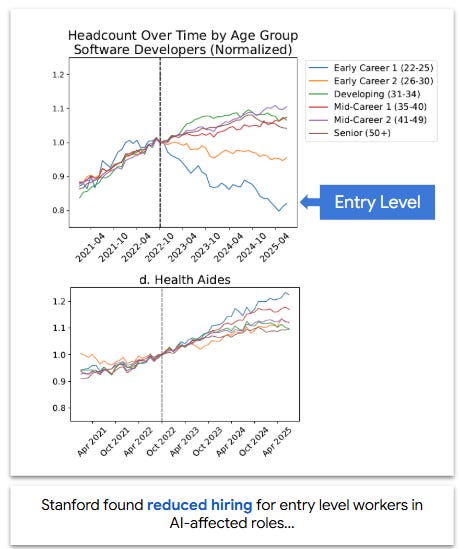
Last week, Stanford researchers provided a new view using payroll data from ADP covering almost 5 million employees and controlling for covid overhiring, return-to-office and interest rates. They found that entry-level workers in fields with heavy AI exposure like software developers and customer service are losing jobs while older employees saw continued growth. This effect did not show up in sectors with less AI exposure like healthcare and retail.
A Foggy Forecast
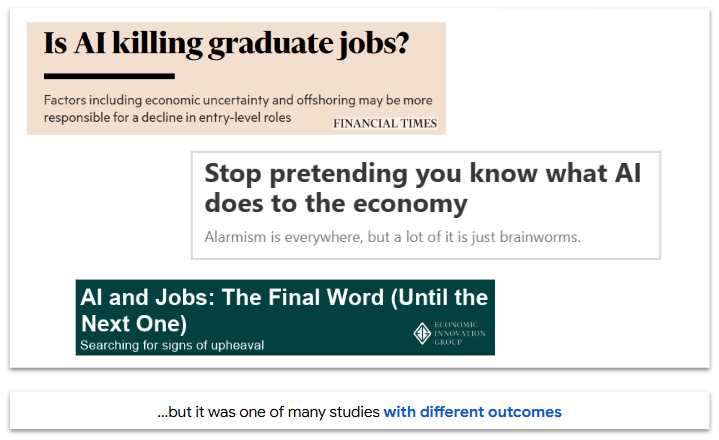
But this study is just one of many. Other research showed a limited impact of AI on jobs, and the entire field is foggy due to a challenging market for graduates who face 20% higher unemployment than older workers.
The Stanford researchers hedged, saying their findings were “consistent with the hypothesis” that AI is displacing entry-level workers. Their canary metaphor was an extra nod to how early we are in a time of change.
What I’m watching: Will AI spark a fresh tech hiring boom? If the next wave of AI startups like OpenAI launch enterprise platforms, history says they’ll need huge teams to support them. Google alone built a 30,000-person organization to run its ads business. At the same time, established companies adopting AI will need extra technical talent on top of their already overloaded IT departments.
The AI Gold Rush
While some young workers struggle, others are striking it rich. The Wall Street Journal recently profiled AI native graduates with machine learning skills who are commanding salaries as high as $1 million per year. Base salaries for entry-level AI professionals jumped 12% from 2024 to 2025, more than any other cohort.
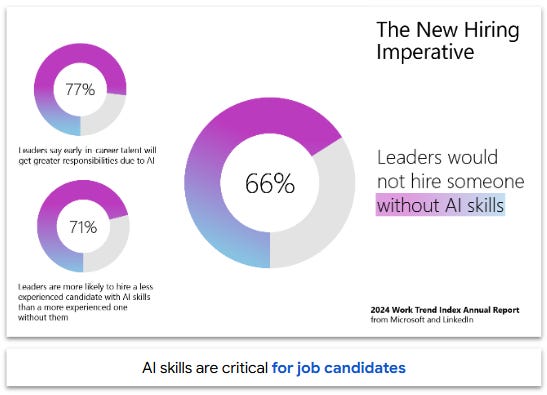
Even outside of technical roles, AI skills are becoming more coveted. LinkedIn reports that job postings mentioning AI literacy have nearly tripled in the past year. A 2024 Microsoft survey found that 71% of leaders preferred less experienced candidates with AI skills over experienced hires without them.
Databricks CEO Ali Ghodsi put it bluntly: “We can’t for the life of us get the more senior people to adopt it… They’re going to come in, and they’re going to be all AI-native.”
What I’m watching: What new sectors will AI create? Just as Uber decimated taxi drivers but created gig workers and the internet hurt newspapers but birthed influencers, AI will create new industries we can’t imagine today. We’re already seeing a massive growth in demand for trade skills to support data centers and power generation projects.
Is the Apprentice Model Crumbling?
My first job was as a programmer. My boss gave me basic coding and testing assignments and reviewed my work before it went live. A few years later, I was the one assigning work to new hires. This is known as the apprentice model where juniors do profitable grunt work, learn from experienced colleagues, and climb the ladder. It’s the backbone of industries like consulting, law and advertising.
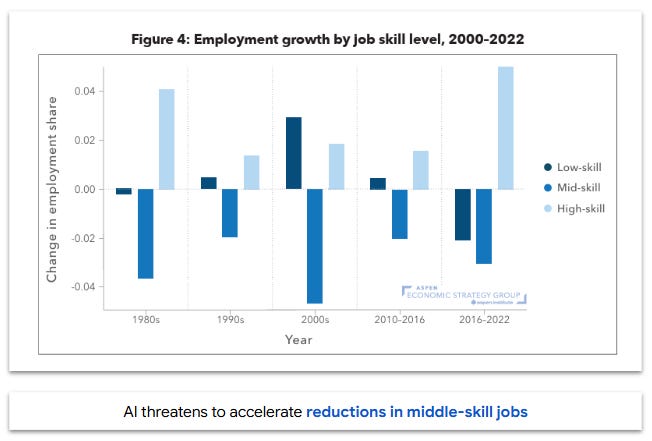
AI is disrupting that ladder by performing work like research, drafting ad copy, and basic programming instead of (and more cheaply than) rookies. At the same time, companies are flattening org charts, leaving managers with less capacity to coach. The result looks like a one-sided barbell: specialists on one side, a thinner management layer, and fewer new hires.
Some firms are experimenting with approaches like discounted billing for juniors, vendor-apprentice swaps, and contract-to-hire fellowships, but none have scaled.
What I’m watching: How will workflows evolve? Consulting firms have been here before. When outsourcing surged in the 1990s and 2000s, they moved routine work abroad and rebuilt entry-level roles around analysis, client work, and project coordination. AI is similar to offshore teams: it can handle routine tasks, but it needs oversight, context, and verification. The question is how entry-level roles will adapt when AI is folded into the mix.
Your AI Career Survival Guide
When I was at Google, we’d tell customers: You won’t lose your job to AI, you’ll lose it to someone else using AI. This once catchy line has now become brutally real. Here are three things every college senior (and employee) should do:
Master AI: AI is becoming the #1 most important skill for employees to learn. Learn ChatGPT and Gemini and apply them to real problems at your job.
Hustle: Find a side project that you can use AI to deliver and show impact. Put it on your resume, and talk about it in interviews.
Stay Flexible: AI will be the first of many new technologies in a 30+ year career. Be ready to change jobs and look for sectors that are growing and value human skills.
Remember those canaries? They are singing, but we can’t tell exactly why yet. What we do know is that the traditional path from college to grunt work to leader will change. Some workers will struggle and fall behind but those who adapt, learn and embrace AI will thrive.
Dad Joke: What did the sick canary say to its boss? “I’m feeling under the feather today.” 🤣